It's hard as nails, it's bug-ridden, and it has no tutorial – but
online zombie adventure DayZ has now been downloaded 1m times, barely a
month after its 'alpha' launch on PC gaming service Steam. Its creator,
New Zealand-born game designer, Dean Hall, has become the latest
independent developer to release a new project before it is finished,
allowing gamers to contribute toward its completion. Potential customers
are warned via a series of titles screens that the game is a work in
progress and that bugs and crashes are commonplace. But this hasn't
stopped hundreds of thousands of PC gamers from pouring hours into the taut, exciting multiplayer action.
Originally written by Hall as a "mod" – or unofficial add-on – for
the popular military shooter ArmA II, DayZ places gamers into the midst
of a zombie apocalypse. Surrounded by unfamiliar landscape and with no
tools to survive, they have to ransack houses to find guns and food,
while avoiding the ravenous undead. The important part is that the game
is online and there are up to 40 other players in the world with you –
you'll either have to compete for resources, usually with deadly force,
or team up to form clans of survivors. Brilliantly, the game supports
in-game chat via headsets and microphones, so players are able to
communicate with each other, plotting their fraught hit-and-run missions
on other gangs. But every once in a while, the game glitches out or
crashes altogether. You just have to re-boot and go back in, reporting
your experiences on the game's packed forums. Launch and hope
DayZ is far from alone in this 'release then adapt' approach.
Although indie coders have often launched new projects in unfinished
formats for fans to download and test, it was crossover smash hit
Minecraft that really transformed the concept into a workable business
model. Markus 'Notch' Persson's ingenious construction game was original
launched in an early 'alpha build' state in 2009 but quickly attracted
an enthusiastic community, who feed back on the game's faults and
features. Now available on PC, console and smartphone the title has sold
over 33 million copies. "The benefits [of early release] are that you
don't have to rely on a publisher, and that you can get people
passionate about the game early on," he told Gamasutra last July. "The added pressure of people already having paid for the game can help motivate you to work on it as well."
So
far, the model has worked particularly well for simulation titles, that
can offer up stable gameplay experiences without the need for advanced
visuals or complex narrative sequences. UK developer Introversion was
effectively saved from closure in 2012 when it made its latest title,
the compulsive jail design sim, Prison Architect, available for online
purchase in an early alpha state. The title is yet to receive a full,
complete launch, but has raised over $10m from its community. Speaking
to VG247 last year, the studio's co-founder Mark Morris explained both
the financial and creative advantages: "I liken the process to steering a
oil tanker – we have our own vision for Prison Architect and we know
the path we are heading in, however we keep a close eye on the forums,
Twitter and Facebook accounts, and the thoughts and views of the
community kind of act like tug boats nudging the tanker in one direction
or another."
The approach has become so successful that key digital gaming service
Steam now has an Early Access section, allowing gamers to select and
support unfinished titles. As with the Kickstarter revolution which has
seen hundreds of games funded to completion via crowds of fans, there is
a sense of ownership over the project. Gamers aren't just
'pre-ordering' an interesting new title, they're potentially
contributing toward its growth. In many ways, there's the same appeal as
discovering and supporting a new band from their days gigging in
flea-pit pubs; it's that sense of getting in there first with something
cool and exciting. Fear and freedom
DayZ, which was apparently inspired
by Hall's survival training while in the New Zealand armed forces,
still has over a year of development left. The big test for 'early
access' games like this is whether the creators can maintain development
momentum under the pressure of user expectation. While community
expectations can no doubt provide impetus to a small development team,
there's always the danger is can be creatively stifling – especially if a
large vocal community has a wide range of opinions on where the design
should go.
But
it's a problem most indie studios would be happy to face. The
smartphone app stores are flooded with game content, and Steam houses
something in the region of 3000 titles, so visibility is now the key
challenge facing smaller developers. Building a proactive community is,
then, a vital part of the development process – indeed, to gain a slot
on Steam these days, developers have to go through the Greenlight system
in which gamers vote on which new titles should get into the store.
The interesting thing about DayZ's success is that this is such an
uncompromising experience. It is not a nice welcoming simulation title,
it is a raw, bleak and almost entirely emergent survival horror game.
The community is the experience. And with a million players,
the lesson it appears to be teaching is – provide a compelling universe
and let participants build from there. Is this the future of traditional
game design, or the end of it?
The
sun is frozen in The Banner Saga's sky, but its beams are yet to melt
its ice-capped landscape. It has, however, thawed a video game genre
that has somewhat languished in recent years: the Tactical RPG.
Extravagantly funded by a ravenous crowd of Kickstarter patrons,
designed by a team of ex-Bioware designers and artists, and scored by
the Grammy-nominated composer Austin Wintory, this is exquisitely
produced fantasy, marrying Game of Thrones-esque medieval war fiction
with the intricacies of a Chess-like combat board game.
Off the battlefield, the team's storytelling heritage is clear. These
vast, Nordic landscapes share a whisper of DNA with Star Wars'
nether-planets, which the team previously crafted while working on Star
Wars: The Old Republic. But the stories that fill them more closely
share the family likeness. The game takes place under a broad sweep
banner narrative involving nations and races (the canny humans, the
hulking Varl giants and their common enemy, a dead-eyed statue people
known as Dredge) on the verge of war. But the wonder is in the close-up
vignettes, the pressures of leading a marching army of cold, hungry
recruits, and the ever-present weight of having to make seemingly small
decisions with unforeseeable consequences. Man management
As you move your soldiers from place to place you watch as they inch
across beautiful, hand drawn landscapes. The view is interrupted every
few seconds with a narrative interlude, some problem or other than must
be attended. One of your men may drink too much mead and brawl. You must
intervene, choosing whether to force an apology from the aggressor or
laugh off the scuffle. Or you might come across a ragtag band of men,
seemingly lost in the woods. Do you allow them to join your ranks and
gain a potential valuable asset, or turn them away?
You accept food from a benign merchant, but what if it turns out to
be spoiled or, worse still, poisoned? Some video games dole out a
handful of these multiple choice decisions per chapter. The Banner Saga
is an endless flow of questions demanding immediate answers. The
consequences must not only be lived with, but also open up further
avenues of choice. Your men may fall. Do you discard the supplies or
wait to see if something else is causing the sickness? Do you force the
men to fight in the next battle, weakened by stomach cramps, or send
them back home? Journey is story. Never has this been made clearer than
in The Banner Saga.
The burden of leadership is made keener by the fact that you are free
to make poor choices: enter a battle in which you are vastly
outnumbered and your troops will fall. Rather than being booted to the
melancholy purgatory of a Game Over screen, the story adapts to your
failure, which the narrative then bears like a scar, forever altering
its trajectory. It takes a little getting used to. But rather than
reaching for the 'load' button to undo your mistakes, there is benefit
to living with them. In time the story feels fully your own. You are no
longer a video game player, pretending to be an active participant in a
pre-set narrative. Instead you are a complicit protagonist, and the game
bends to your will – good or ill.
Advertisement
On
the battlefield this is a finely tuned yet somewhat traditional
tactical RPG. You choose a selection of warriors and take turns with the
AI to move them one-by-one about the gridded board. First you choose
where to position a unit according to its range. Then you choose to
attack an enemy, targeting either its armour or its health. The former
indicates how many points of damage a character can deflect while the
latter represents the amount of damage they can do, a number that
ingeniously doubles for their health points. In this way, as units
sustain damage, they are simultaneously weakened.
Different characters specialise in different classes: sheildmasters
have high defense and are useful for forming a defensive wall in front
of weaker characters; archers can attack from a distance yet are weak at
short range; spearmen can attack foes two squares away and so on. Your
characters earn Renown points every time they defeat an enemy and this
currency can be used to increase their abilities or, alternatively, to
buy stat-enhancing accessories.
Battle tactics
The strategic element to fights is rich. "Willpower" points can be
used to increase a unit's range or its offensive potency (and this
limited, move-enhancing currency can instantaneously turn a battle's
tide). Strategic arrangement of your troops is key to success – the Varl
take up four squares on the grid each, and will block both their
comrades and competitors' movements. In larger fights there's even an
option to continue the battle after it's won, with the potential to
defeat more of the opposing army's soldiers, albeit with the increased
risk of fighting with already weary and wounded men.
However, the consequences to actions on the field feel less keen than
they do off. If one of your troops falls in battle, they resuscitate as
soon as it's finished, requiring only a few days "off" to recuperate to
full health again. You cannot lose the key players in the drama on the
battlefield, even if a few can be lost quite easily by making the wrong
decisions elsewhere. This is, nevertheless, a game with a strong sense
of place and the ambiance elevates it beyond the immediate competition.
The illustrated 2D art is expressive, while Wintory's score is nothing
short of extraordinary – evocative, unusual and rousing. The designer
Sid Meier famously said that a game is a series of interesting choices.
It's a maxim fully embraced by The Banner Saga, which stitches those
choices into its very fabric to form a tapestry that is wholly your own.
New weapons, new courses, end-of-race highlights and an ice-cold Luigi. How are you finding Mario Kart 8? Mario Kart 8 has been out in the UK for a few weeks now, leading to a large increase in sales
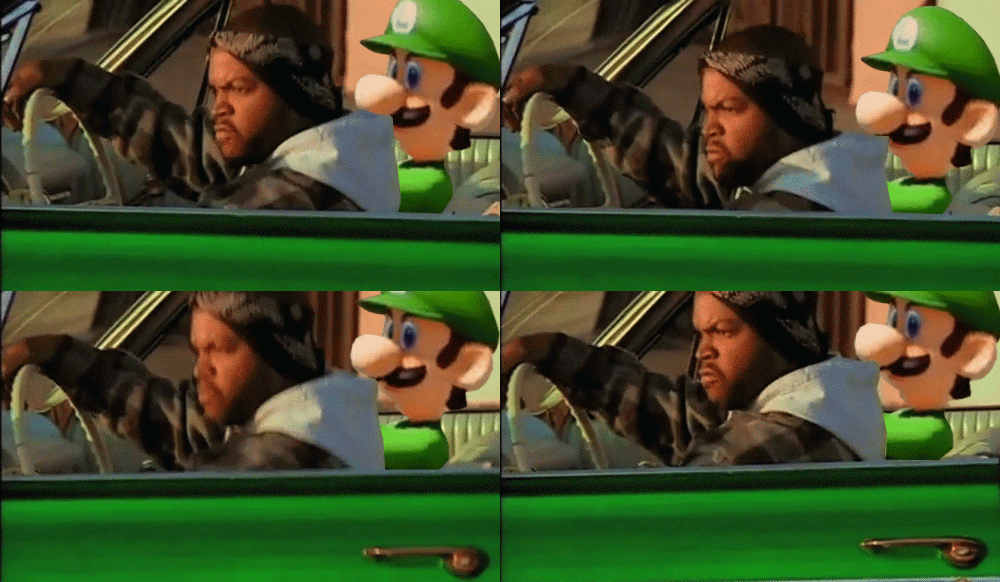
for the Wii U console. It's even seen the birth of its own meme: the
Luigi death stare, a celebration of the lesser-heralded Mario brother's
ice-cold reaction to the administration of shell-based justice.
I spent the weekend getting to grips with the latest Mario Kart iteration, sunny weather eschewed in favour of relentless four-player action.
Early impressions are positive. The karts drive, glide and slide like a dream, and as our review points out,
the new weapons are a satisfying addition. And there are little
pleasing tweaks that make logical sense: if you plunge off the course
into a cute ravine, lakitu
returns you to the track much more efficiently than before, power-up
boxes reappear a touch more quickly, and there is now a means of
combatting the blue shell. At last.
And, as the Luigi death stare
indicates, the end-of-race highlights (which you can edit and upload to
Youtube) are an absolute joy. We almost enjoyed watching each hit, in
glorious high-def slow-mo, as much we enjoyed playing the game itself.
As many have mentioned, the only bugbear is battle mode, which now
takes place on the standard courses rather than ready-made arenas, and
this is a real step backwards. "I can't find anyone," and "it's taking
ages, isn't it?" were standard responses when we tried it.
Now it's over to you. How are you finding Mario Kart 8? Is it the
best one, or do you still pine for the SNES or the underrated Game Cube
versions? Share your thoughts - and links to your own killer videos, if
you've made any - in the thread below.
History is not always kind to great games. Titles once heralded as
masterworks are often lost as console cycles turn. Alternatively, there
are the offbeat outliers completely shunned during their own lifetimes,
only to be quietly ransacked by later generations of designers.
Over the next three days, we'll be remembering 30 brilliant,
idiosyncratic, challenging or just plain weird titles that have been
erased from the gaming annals, or at least criminally overlooked. Each
one of these did something interesting with gaming, but not interesting
enough to be endlessly recalled in misty-eyed retro articles or on Charlie Brooker-fronted TV shows (which are otherwise excellent and include really great interviewees).
Here then are the first ten. Come back for the others, and add your own favourites in the comments section.
3D Deathchase (Micromega, ZX Spectrum, 1983)
Public domain
Written by lone coder Mervyn Estcourt (who also produced a PC remake
almost 20 years later), this remarkably progressive 3D chase game gets
the player to ride a futuristic motorbike through dense woodland,
attempting to track down and shoot enemy riders. The first-person view
and smooth sensation of movement were astonishing at the time
(especially considering it ran on the older 16k Spectrum), and it no
doubt prepared the way for future variations on the free-roaming driving
game.
Aliens: The Computer Game (Software Studios/Electric Dreams Software, C64/Spectrum, 1986)
Public domain
Activision developed a higher profile tie-in with the movie, but this
version is far superior and has lasting significance in game design
terms. It's essentially a prototype first-person shooter, complete with
moveable targeting reticule. Players have to guide six of the film's
characters through the colony base, toward the queen's lair. Although
movement is essentially limited to left and right (firing at doors lets
you pass through them), the action is tense, and the importance of quick
accurate aiming hints at the FPS genre to come. There's also a
brilliantly unsettling take on the movie's motion tracker sound effect
that ramps up the scare factor considerably. And when the face huggers
leap at you it is TERRIFYING.
Alter Ego (Activision, C64/PC/Apple II, 1986)
Public domain
Designed by psychologist Peter Favaro and released by Activision,
this fascinating life simulation gave players control over either a male
of female character as they progressed from childhood to grave.
Designed around a series of key decision points, the mostly text-led
experience was based on hundreds of interviews conducted by Favaro, and
was hugely critically acclaimed at the time. Alongside David Crane's
Little Computer People it laid the groundwork for modern era 'virtual
soap opera' The Sims. Alas, the sparse presentation and offbeat concept
meant that the sim sold poorly and a proposed sequel, based around
rearing a child, was scrapped. You can play the original game online.
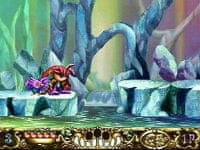
Astal (Sega, Sega Saturn, 1995)
Public domain
Golden Axe, Streets of Rage, Altered Beast... Plenty of Sega's
classic side-scrolling beat-'em-ups have gone on to become legends of
the genre. But somehow this beautiful early Saturn release has been
over-looked, perhaps thanks to the console's untimely demise. Banished
from Earth by an angry goddess, the eponymous hero must return to rescue
the girl he loves. Okay, forget the horribly trite story and revel in
the gorgeous hand-drawn artwork and interesting attacks, which allow
Astal to blow his enemies over or wrench trees out of the ground to
chuck at them. There's also an innovative but tricky co-op mode which
puts player two into the role of Astal's bird sidekick. Watch this playthrough for a taste of the wonderful character and landscape designs.
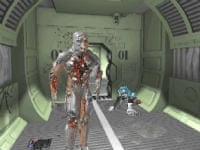
Bioforge (EA/Origin, PC, 1995)
Public domain
The 'interactive movie' genre of the mid-nineties brought us plenty
of nightmarishly unplayable dross as game developers fell in love with
the idea of using full-motion-video to create, ugh, 'cinematic'
experiences. But there were some fascinating examples, too, like this
cyberpunk adventure, set on a moon base governed by religious maniacs
who believe man must evolve toward a machine hybrid state. The player
awakens as a cyborg and must escape the lab, piecing together the plot
from PDA diary entries and using security and computer equipment to hack
defenses. Elements of Deus Ex, Bioshock and Dead Space all combined to
create a tense and interesting adventure. It was so expensive to
produce, however, that low sales ensured a planned sequel never arrived.
Edge later published an excellent 'Making of' feature.
Bust A Groove (Enix/Metro Graphics, PlayStation, 1998)
Public domain
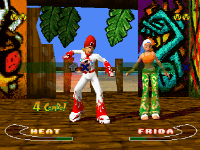
This formative rhythm action game allowed players to pull ridiculous
disco moves by following onscreen direction prompts, in a similar manner
to Sony's revered PaRappa The Rapper. The difference here was the
head-to-head competitive dance fighting element, which allowed players
to knock each other off the beat with special moves. featuring an
excellent old school electronica soundtrack, bizarre characters and
super-smooth animation, the title helped build the 'post-pub gaming'
credentials of the PlayStation, and spawned a sequel. But then Konami's
all-conquering Dance Dance Revolution strutted in and kicked it from the
dance floor.
ChuChu Rocket (Sega/Sonic Team, Dreamcast, 1999)
PR
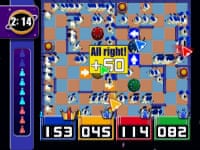
How this frenetic combination of Pac Man, Bomberman, Lemmings and
Hungry Hippos failed to become a continually updated gaming staple is
beyond us. Designed by Sonic co-creator Yuji Naka its a fast-paced maze
puzzler in which players have to place arrows on the floor to direct a
line of mice into rockets so they can escape the giant cats. In the
four-player mode, participants can also use arrows to direct the feline
enemies toward competitors, making for fraught, hugely tense encounters.
Given away free to European Dreamcast owners, the game would later
surface on GameBoy Advance and iPhone but should – if there were a whiff
of justice in the universe – be on every single console released from
1999 to the end of time.
Devil Dice (Sony/Shift, PlayStation, 1998)
Public domain
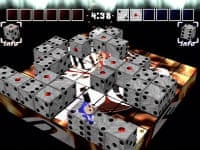
A modest success on its release and followed by two sequels, this
ingenious puzzler was briefly revered, but has somehow slipped from
wider memory. Players must navigate a grid by stepping on and turning
dice cubes – when the numbers match between two adjacent cubes, they
disappear. It's sort of a numerical match-three puzzle, bringing in some
of the deeper mathematical reasoning of Area/Code's masterful iPhone
title Drop 7. Originally created using Sony's home programmable console,
the Net Yaroze, it was one of the few 'homebrew' titles to see release
on the PlayStation.
PR
Resident Evil 4 wasn't the only standout survival horror experience
on Nintendo's under-rated GameCube system. Developed by Canadian studio
Silicon Knights and originally meant for the N64, Eternal Darkness is a
fascinating Lovecraftian romp following student Alexandria Roivas as she
investigates a book known as the Tome of Eternal Darkness. The powerful
artifact provides a portal to a selection of previous lives, all of
which must be experienced by the player in order to prevent an ancient
evil from re-surfacing. The narrative and locations are creepy and
unsettling, but the best part is the sanity meter which drops when you
encounter enemies, causing visual disturbances and even tricking you
into believing your TV has broken. Critically acclaimed, but with its
mature rating, Nintendo fans weren't quite sure what to make of it. A
proposed sequel never materialised, despite Nintendo renewing the
trademark as recently as 2012. Meanwhile, many of the original
development team went on to form Precursor Games and planned a spiritual successor named Shadow of the Eternals which sadly failed to hit its crowdfunding target last year.
PR
On a break from the highly successful Hitman series, Danish studio IO
Interactive launched this innovative third-person squad-based shooter,
getting to the whole America-invaded-by-Communists plotline years before
Call of Duty. You play as a regular Joe running round New York taking
on Russian troops – and the more you kill, the more your 'Charisma
rating' goes up allowing you to recruit followers. That's right, it's
Homefront meets Twitter. Great controls and smooth squad commands
ensured a thrilling yet surprisingly tactical experience. Maddeningly,
it seems a proposed sequel was put on indefinite hold so that the studio
could work on... Kane & Lynch. Wha... why?!! Anyway, Eurogamer has a
nice retrospective on the game right here.
During the summer of 1992, between my first and second years at
university, I was working at a video game studio in Leamington Spa. We
were supposed to be coding a game called Tank Commander for the PC, a
long forgotten battle simulation – but one day someone brought in a Game
Link cable, which allowed the connection of two Nintendo Game Boy
consoles together. Of course, we immediately loaded up the Tetris
competitive mode, in which any lines you cleared on your own screen
would be cruelly transferred on to the bottom of your opponent's stack.
Work ground to a halt and didn't really start up again for several days.
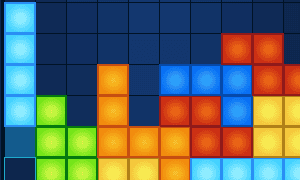
Most gamers have Tetris addiction stories. Since Russian programmer
Alexey Pajitnov first developed the falling shape puzzler while working
at the Moscow Academy of Sciences, it has sold hundreds of millions of
copies on more than 50 different hardware platforms. Scientists and
designers have pondered over its incredible appeal, the extraordinary
compulsion people have to fit variously shaped tetriminos into a bucket.
The beauty of Tetris is its simplicity – you need to understand no
archaic conventions or rules of gaming. It is also essentially about
something that we all find intrinsically satisfying: tidying up. Tetris
is about imposing order, even if the task is Sisyphean, because the
shapes don't stop falling until your stack reaches the top of the
screen. And then it's all over. Tetris in the brain
The purity and popularity of the game have made it one of the most
researched and analysed on the planet. Countless papers have been
written on its cognitive effects. In 2009 research published in BioMed Central
suggested that playing Tetris could strengthen the neural networks in
the brain, perhaps even improving memory. In the same year, researchers
at Oxford University found that
Tetris could help reduce flashbacks in sufferers of post-traumatic
stress disorder. Most of us just joked about the "Tetris effect", the
worrying after-image of falling blocks behind our eyes and even in our dreams.
Advertisement
Since
the original prototype was developed by Pajitnov on an ancient
Electronica 60 computer, the rights to the concept have been swapped,
fought over, brought and more-or-less stolen dozens of times. The
publishing history of the game is a complex puzzle in its own right (and
to find out more you should immediately watch the documentary Tetris: From Russia With Love).
There have been various attempts to update the recipe. 1989's Super
Tetris added a smart bomb, 2001 title Tetris Worlds brought in a story
mode(!), and introduced "hold" and "easy spin" mechanics. Later,
Electronic Arts toyed with the brand for a while, producing the decent
Tetris Blitz (which bought in an against-the-clock dynamic) before
blotting its copybook entirely by trying to add a subscription service to its iOS Tetris port. Tetris unbound
These were sort of interesting, but most players saw them for what
they were – rather desperate attempts to re-sell a concept that worked
fine in its cheaply and readily available traditional incarnations.
Although, if we're going to to get really into this, the four-player
mode in the Nintendo 64 title, Tetris 64, was pretty special, as was
crossover classic Tetris With Card Captor Sakura, by longtime Street
Fighter developer Arika. That company actually produced some of the
finest Tetris spin-offs in the form of its Tetris: The Grand Master
series. Here is expert player Jin8 besting Tetris Grand Master 3. It is
pretty incredible:
There were also lots of very good rivals, including Jay Geertsen's
Columns, later licensed by Sega for various platforms including the Game
Gear, the manufacturer's rival to Game Boy. Better though was the
gloriously kawaii Puyo Puyo series, originally from Japanese studio
Compile. Even Mario got in on the scene with 1990 title Dr Mario, which
replaced all the shapes with differently coloured pills in what was
clearly a tribute to acid house culture. (I'm kidding.)
Advertisement
Now
another giant publisher, Ubisoft, has announced that it is working with
the Tetris Company – the organisation co-founded by Pajitnov that now
owns the right to the brand – to produce new versions for the Xbox One
and PlayStation 4. So far it has given nothing away about what these
games will look like or what new features will be added to take
advantage of these ultra powerful machines – but surely new modes and
functions will appear. What will they look like? Will it make use of the
console's connectivity to offer vast global leaderboards like Tetris Zone?
Will we see cloud support? A persistent massively multiplayer Tetris
arena, thousands of blocks wide, which a global audience must keep from
spilling over?
Perhaps there will be Tetris Kinect, where you shout, "turn it left,
no LEFT, now drop it, no not there, THERE!" Maybe Ubisoft will bring in
some of the epic narrative sweep of the Assassin's Creed series. It
turns out that this version of Tetris is being played in a vast national
security mainframe, and players have to hack the code to escape the
distopian nightmare. Are we going to get Tetris Rayman, the unlikely
combination of block-falling puzzler and Ubisoft's invisible-limbed
platforming mascot? Is there something in the Geneva convention that
could stop this from happening?
One thing is certain, while there are computers to play games on
there will be Tetris. It defies barriers of language and culture, it is
interactive entertainment in its purest form. Somehow, Pajitnov
discovered a hotwire to the brain; an experience that talked to the
central processing unit of human cognition in its own machine language.
And like the rest of the industry, despite following up with several
sequels, the puzzle-obsessed coder has not repeated the brilliance of
Tetris. But of course we should be reminded of the apocryphal story
about Joseph Heller. When told by an interviewer that, since Catch 22,
he had never managed to write anything as good, he replied, "No, but
then neither has anyone else". Pajitnov can quite securely make the same
claim.
Eidos
Montreal's reboot of the respected stealth-'n-steal series is out in a
month. Here's what is right – and wrong – with the return of Garrett,
the master thief
Thief – the murky streets are filled with unexpected treasures. And also violence, of course. Photograph: /PR
As obvious as it sounds to say so, in Thief you nick things. You nick
a lot of things. Broaches, necklaces, wallets, candelabras – anything
valuable that’s lying around, really – all disappear into lead character
Garrett’s bottomless sack. You find some of these trinkets in the
oddest of places. One would expect to find a golden bracelet or two in a
wall safe behind a painting, but who on earth leaves a goblet on a
rooftop or a couple of coins at the edge of a pond?
It’s possible Eidos Montreal has left these treasures scattered
around its game in order to put players into the headspace of its
protagonist. If that’s the case, it’s an absolutely brilliant piece of
game design because stealing stuff in Thief isn’t just fun, it’s addictive.
After you’ve snagged your first five or six baubles, you turn into a
veritable magpie, filled with the need to obtain any shiny object that
catches your eye – even if it means potentially exposing Garrett to
danger in order to do so.
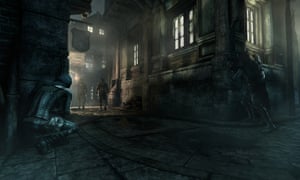
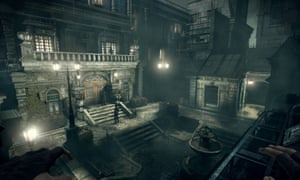
Victorian architecture and glowing lamps dominate the cityscape. Photograph: /PR
This compunction to loot is backed up by the game’s open-ended
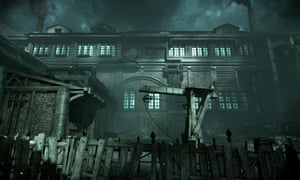
structure and its seductive visuals. Thief is set in a gloomy urban
sprawl where the architectural schools of Gothic Europe, Victorian
London and Steampunk Sci-Fi seem to have collided in a mass of fog and
iron. Garrett, the antihero of the series since its 1998 premier, it
back, returning to his home town, which is now in the grip of both a
horrendous plague and a tyrannical ruler, The Baron. A palpable sense of
foreboding drapes over the city’s gas-lit streets and shadowy rooftops,
an effect that's bolstered in no small part by the flashes of lightning
that briefly throw Garrett’s shadow onto the walls and pavements around
him.
Advertisement
As
sinister as all of this sounds, it becomes apparent early on that the
city’s darkened alleys and rooftops are Garrett’s natural turf. His
almost superhuman ability to move noiselessly through his surroundings
turns the skyline into his thoroughfare and makes every shadow inviting.
Garrett also has the ability to ‘swoop’ in and out of pools of light
quick enough to avoid detection and he’s armed with a decent array of
equipment including lockpicks, arrows and a crowbar to force open the
odd window. Stolen moments
From the evidence of the preview build I had a hands-on with, Thief
contains the odd brief linear passage, which helps move the narrative
along, but once Garrett is in view of a building that houses a valuable
item he’s after – whether it’s part of a side task or a story mission –
Thief’s structure opens up. Couple this loose framework with the
kleptomaniacal impulses instilled in the player early on, and the world
in Thief simply begs to be explored.
A great example of this came in a passage of play that occurred after
the game’s tutorial level. Following a bungled robbery, Garrett has to
flee back to his headquarters through one of the city’s mercantile
districts. As I picked my way across the rooftops, noticing one of the
streetlamps below me was on the blink, I heard a couple of guards
remarking on how beautiful a golden mask in the window of a jewelry shop
looked.
Well, I thought, since it’s on my way…
The jewelry shop raid showed there’s no set way to successfully pull
off a burglary. It was possible to enter the premises by observing the
nightwatch guards, taking note of their patrol patterns, timing one’s
movements to reach the shop’s door undetected and then picking the lock.
Alternately, I found after circling the emporium that one of the back
windows was open and it was possible to enter by shimmying up to the rooftops.
Advertisement
Once
inside, I found that the open-ended nature of progression extended to
the style of play, too. To wit, players can proceed as loudly or as
quietly as they wish, although, they’ll find that playing to Garrett’s
strengths – moving stealthily and hiding from view – will prove easier
in the long run.
In my run-through I found one guard on patrol in the front of the
shop, but incapacitating him was easy enough. Once I’d helped myself to
everything that wasn’t nailed down on display, I picked the lock of the
window display case and found that the mask in the window that had so
impressed the guards was actually gilded glass – and thus, worthless. At
this stage I could’ve easily made my exit but I decided, since I’d gone
to the trouble of breaking and entering, to explore more of the shop. Waiting game
I’ll neither reveal what else I found, nor will I reveal any details I
uncovered about the game’s plot. Believe me when I tell you I’m doing
you a favour. The less one knows about the game’s story and its hidden
gems, the better time one will have when it’s released at the end of
next month. That is, if the developers manage to sort out a couple of
issues that, while not deal-breakers, are irritating nontheless.
Garrett’s inventory, for example, is mapped to the touchpad on the
PS4’s controller, but the way it’s been implemented renders it virtually
useless. Selecting items involved hammering the touch pad and while
this is irritating enough during sections of the game where players have
a lot of time to consider their next move, it would be potentially
infuriating if they’re under duress.
A plague threatens the clearly otherwise joyous city.
Second, I can report that Thief has a lot of beautiful loading
screens, and it's a good thing that they're beautiful, because players
will be staring at them for an awfully long time. Loading times feel
interminable and when they appear after a dramatic cutscene, they manage
to break the atmospheric spell the rest of the game is so successful at
weaving. Facial animations also look positively last-gen, which is
strange because the environments surrounding the characters are
fantastically detailed and beautiful to behold.
Here’s hoping Eidos manages to tighten up these flaws because they’re
sizable chinks in Thief’s armour. Without them, there’s a lot in this
game to admire and the pull of its world is intoxicating. Thief puts
players into the headspace of a light-fingered ne’er-do-well and drops
them into a city filled with trinkets to steal and houses to break into.
Even with its niggles Thief accomplishes what the best adventure games
set out to do – it surrounds you in a world you could get lost in and
then encourages you to do just that. • Thief is released on PC, PS3, PS4, Xbox 360 and Xbox One on 25 February (US), 27 Feburary (Aus) and 28 February (Europe)
In 2005, when my brother Euan was still a schoolboy, we used to play a
lot of Tekken 5 together. If you’re new to this famed video game
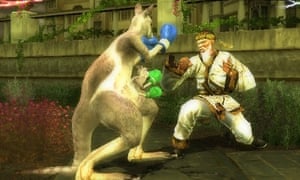
series, it’s a one-on-one martial arts simulation - a ferocious yet
endearingly flamboyant experience in which kangaroos trade blows with
Bruce Lee clones, and winged demons grapple with Mexican wrestlers. And
I’m fairly sure Euan is the most savage, unprincipled Tekken 5 player
ever to lay his traitorous fingers upon a PlayStation
2 controller. Some combatants prefer to open a bout with a stunning
punch to the lower body, but Euan was rarely that noble. “Wait a minute,
I want to show you something,” he'd declare, scuttling out of reach.
I'd dutifully wander over to his side of the arena, all patronising
solicitude, and he'd kick me in the face.
Euan is a dirty fighter. But he's also one of the most fearlessly
imaginative people you'll meet. And in its own small way, our shared
gaming hobby is proof of this.
There have been greater feats of
cunning than his Tekken 5 antics, but I like that this gambit ducks
right under the question of manual dexterity. Because on those, purely
functional and “sportsmanlike” terms, my brother has a bit of a mountain
to climb. He has Down's syndrome, a genetic disorder that reportedly
affects one in every thousand babies born in the UK each year, which
often hampers development of fine motor skills. I've never been entirely
sure what Euan thinks of his condition - if you're reading this, Euan, I
apologise in advance for any stupid assumptions. Still, I can’t help
but wonder whether his refusal to fight on terms that leave him at a
disadvantage reflects something larger, a rejection of the role society
wants him to play.
Video games v expectations
We expect “disabled” people – that’s to say, the vast spectrum of
individuals branded as such for convenience’s sake – to be passive,
unaware, content to live within tacit, carefully managed social nooks in
exchange for support and guidance. We don’t expect them to recognise
such overtures for what they are: well-meant, but limiting. We don’t
expect them to break the rules. We don’t expect them to cheat.
Advertisement
By
contrast, most video games outright encourage you to misbehave, or at
least refrain from bringing down the gavel when you do: it's what makes
them such wonderful, liberating escapism. Just look at Timesplitters 2,
the work of Nottingham-based developer Free Radical Design. A deranged
cartoon shooter, it tracks how each player conducts him or herself over
the course of match, and offers an appropriate award. As a rule, I’d end
up with something like “hypochondriac” (for picking up medical kits
when you're unhurt) or “backpeddler”. My brother, meanwhile, walked away
from each round with a toxic cocktail of judgments usually including
“most cowardly”, “bully” or “ricochet king”. He's a sneaky player.
Euan and I don’t play Timesplitters 2 anymore, mainly because the
disc has come to resemble a half-digested beermat. Nowadays we're fond
of Gears of War: Judgment for the Xbox
360, a science-fantasy shooter in which granite-jawed marines scuttle
around blasting hideous cave mutants with chainsaw-guns. It's an
opportunity for Euan to flaunt his own, oddly 80s sense of machismo,
equal parts Steven Seagal and The Village People – he's taken to
somersaulting his character in time to a raucous rendition of Everybody
Mambo. There's nothing in the game's world or fiction that accounts for
this behaviour, of course. It's just his personality at play.
No man behind
Another favourite is Left 4 Dead 2
(also on Xbox 360), a brilliant riff on B-movies from Valve Software,
the games industry’s indefatigable pioneer and prankster. Though a world
apart from Timesplitters in most respects – the idea is to carve a path
through hyperactive crowds of Danny Boyle-era zombies, from one
safehouse to the next – Left 4 Dead 2 compares to Free Radical's game in
that in effect it is a personality test. The nature of the threat isn’t
pre-determined but protean, shifting in response to your traits and
tactics.
Cower for too long at the mouth of a street, and Valve’s vaunted
“Director”, a bundle of code with a Stanford complex, might sneak a few
grumpy corpses into the road behind you, a none-too-subtle hint that
you’re letting an unseen audience down. Split from the group in a fit of
zeal and you’re asking to be pinioned by an elite nasty like the Hunter
(imagine one of David Cameron’s huggable hoodies, cross-bred with a
panther). Euan gets along famously with Hunters. He’s also
well-acquainted with the Witch, a sinister, weeping apparition who won’t
bother you, providing you don’t bother her. Suffice to say that we
seldom leave a Witch to her own devices, and I'm usually the one who
winds up a broken ruin in the process.
Left 4 Dead by Valve – a game about surviving the zombie holocaust, preferably without your brother goading the undead
And yet - my brother has never once abandoned me to my fate. His
delight at leaving me in the lurch is exceeded only by the satisfaction
he seems to feel at being my rescuer: it's another way, I guess, of
refusing to be the kind of individual he's expected to be.
Each of Left 4 Dead’s chapters or “campaigns” concludes with an
all-or-nothing gauntlet run or final stand in the face of overwhelming
odds. You might have to defend a rock stadium while waiting for a rescue
chopper, using concert pyrotechnics to set the undead on fire, or
refuel a car in the middle of an infested shopping mall. We're rubbish
at these sections, but that's OK - dying in Left 4 Dead is often much
more fun than surviving. The point isn’t so much to succeed as to share
the experience of a protracted and hilarious failure, as best-laid plans
fall to the Director’s tricks and only-human feats of incompetence or
treachery.
Clegg v sense
Games like Left 4 Dead can be every bit as exhilarating and convivial
as a real-life sport. It's frustrating that so many people continue to
regard them as degrading and desensitising. Parents should “ration” a
child's consumption of “corrosive” videogames, father of three Nick
Clegg observed on LBC in September,
adding that players “occupy a sort of hermetically sealed world really
of their own, and that can have a very detrimental effect”. The idea of
joining in, much as you'd join your kids for a game of football, doesn't
seem to occur to Clegg – but how are we to lure people out of that
“world”, assuming this is necessary, if not by comprehending what makes
it so enticing? And what possibilities are we dismissing in the process?
Quantum of Solace – this mediocre James Bond tie-in may have hidden benefits.
My brother has been playing video games for well over a decade. If
this has had “a very detrimental effect” on him, he hides it very well,
though I suppose there is that slightly unnerving fixation with James
Bond. This has been the cause of some strife: I'll travel home for the
weekend armed with a critical darling like Bioshock Infinite - think
Martin Scorcese's Gangs of New York meets David Mitchell's novel Cloud
Atlas - only to discover him tucking into his battered old copy of
Quantum of Solace, a middling adaptation of the Daniel Craig film. I've
hidden the disc on occasion. Not proud.
The value of Bond
Advertisement
My
brother’s dedication to Quantum of Solace may actually have been
constructive, much as I hate to admit it. Years ago, he'd ask me to help
out with the game's number puzzles (hacking into an electronic door
lock, for example) and Quick Time Events - “on rails” sequences that are
shot and edited like the action bits in any garden-variety blockbuster
movie, where you tap buttons on cue to make it through unscathed.
Nowadays, Euan is able to perform these without assistance. Is this
evidence that his time in 007's shoes has honed his reflexes and
improved his numeracy? Possibly. There's growing support for the idea that far from damaging youngsters, games can actually aid cognitive development and have educational benefits.
Equipped with tools, objectives and obstacles, a game is analogous to
a classroom, a crucible in which to test out and master all sorts of
principles. That the principles transferred (eg where best to punch a
kangaroo) may not be worth the trouble is no argument against the
medium’s efficacy. Among the organisations that acknowledge this is the
National Security Agency: in documents
published by the Guardian in November, our friendly neighbourhood G-men
note that both the US army and Lebanese Hezbollah have developed games
for training and recruitment. I like to think that the NSA has a file on
Euan. He could certainly teach them a thing or two about underhand
tactics.
Visual learning
It's possible that children with Down's syndrome have more to gain
from “edu-tainment” software than they do traditional teaching methods,
as I learned during a conversation with Gillian Taylor, an occupational
therapist at UK gamer's charity Special Effect.
“People with Down's syndrome are very visual learners,” she tells me.
“So they learn much better from visual materials than auditory materials
or other learning styles. If you think about how much computer games
give you visually, I think that could be a real benefit.” This may be
especially true of touchscreen games, which allow players to meddle with
an image without first mastering a control device.
I'm not trying to claim that every child born with the condition
belongs in a virtual reality booth. In Gillian's view, “people with
Down's syndrome are as different as people generally, in terms of the
spectrum of skills that they have” - some will go to college, like Euan,
others may not, and blanket solutions are of use to nobody. But where a
real classroom may seem threatening to a person who isn’t as literate
or socially adept as his or her peers, games at least offer a controlled
environment in which to hang out and experiment with concepts.
Learning something isn't necessarily the point - success of any kind
is good for you, whether you experience it in the real world or not.
“Motivation can be a problem for people with Down's syndrome,” Gillian
observed. “If they're not getting any success with things, they're not
going to develop the self-esteem, and they're not going to want to try,
and therefore the skills aren't going to build. The right game can offer
the right challenge, enabling them to enjoy success, which in turn
motivates them to progress further.”
Freedom and control
The right game can be hard to find, unfortunately, which is why
Special Effect puts on roadshows throughout the UK, where players of all
abilities can try out the charity's colossal library of tailor-made
control devices, many of them based on commercially available hardware,
like Sony's DualShock pad. Examples include a peripheral that allows you
to drag and drop virtual chess pieces with your eyes, and an intricate
device that makes it possible to play a 3D shooter using chin movements,
voice commands and a switch mounted on the side of a chair.
“Our role there is as facilitators to help them experience a range of
games with different speeds, cognitive levels and control
complexities,” says communications chief Mark Saville. “The magic
happens when they experience games that match their abilities.” These
events are also on opportunity for friends and loved ones to experience
these titles; in helping those with disabilities get to grips with a
game, Special Effect is helping to lower the entry threshold across the
board.
Perhaps the leakiest preconception about video games right now is
that they can't be shared - that gaming is an adolescent cult practise,
inaccessible to any except card-carrying enthusiasts. But a world is
only “hermetically sealed” if you insist on being outside it - and
ultimately, the loss is yours. Playing games with my brother has made me
more conscious of his spontaneity, his guile and resourcefulness, his
intellectual independence and irreverence. It’s one of many ways he
reveals himself not as a “disabled” person but simply as his own person,
as hell-bent on deciding his own destiny as anybody else.


 New weapons, new courses, end-of-race highlights and an ice-cold Luigi. How are you finding Mario Kart 8?